



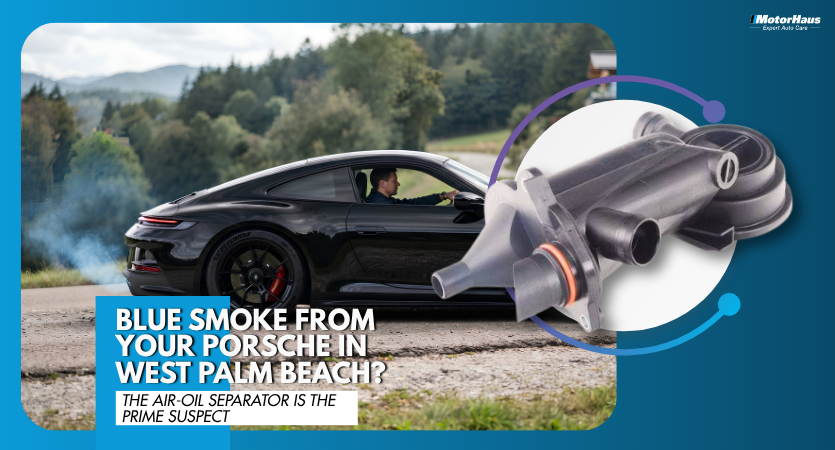
You’re on I-95 south of Okeechobee Boulevard in mid-July, windows up, the AC fighting a 92-degree soak, and a haze of blue smoke drifts up at the light. Your Porsche is drinking oil. That’s a bad sign.
On a Boxster, Cayman, 911, or Cayenne, smoke plus a rough idle usually points at one part — the air-oil separator (AOS) — and West Palm Beach summer heat is exactly what pushes a tired one over the edge. A failed AOS can pull oil into the intake and hydro-lock the engine, turning a routine job into a five-figure rebuild. If your Porsche smokes, whistles, or burns oil this summer, get it checked before the next drive.
Quick Summary: Key Takeaways
- Watch for blue smoke: A gray-blue cloud on cold startup or hard throttle is the classic tell of a failing air-oil separator.
- Listen for a whistle: A steady vacuum whistle from the engine bay often means the AOS diaphragm has torn.
- Heat speeds the failure: Florida underhood temperatures bake the AOS plastic and rubber, so failures cluster in July and August.
- Don’t keep driving it: A collapsed AOS can hydro-lock the motor — a $10,000-plus mistake on a flat-six.
- We prove the diagnosis: Digital inspection reports with photos show you the cause before we quote a dime.
The Air-Oil Separator Keeps Oil Out of the Intake
The AOS pulls oil mist out of the crankcase gases and routes clean vapor back into the intake to be burned. When it works, you never think about it. When the diaphragm tears or the housing cracks, raw oil gets sucked straight into the intake tract, and that is where the smoke, the fouled plugs, and the oil consumption all begin.
It’s a cheap part doing a big job. On most Porsche flat-sixes the separator is buried against the engine, so the labor — not the part — is where the cost lives.
The Symptoms Palm Beach Porsche Owners Notice First
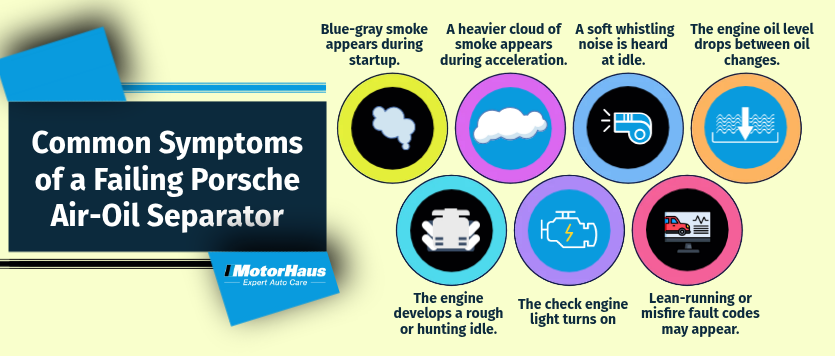
The first clue is usually smoke. A blue-gray puff on startup, or a heavier cloud when you get on the throttle merging onto I-95, means oil is burning where it shouldn’t. You may also hear a soft whistle at idle, watch the oil level drop between changes, or feel a rough, hunting idle at a Clematis Street stoplight.
Sometimes the check engine light joins in. Codes for lean running or misfires often trace back to a separator pulling a vacuum leak. Small signs. Real problem.
West Palm Beach Summer Heat Ages the AOS Faster
Heat is the accelerator here. The AOS relies on a thin rubber diaphragm and a plastic housing, and months of 90-degree days plus stop-and-go traffic on Okeechobee keep underhood temperatures brutal enough to make that plastic brittle and the rubber crack years ahead of a cooler climate. Summer doesn’t cause the design flaw. It just exposes it early.
An overheating or oil-starved engine is one of the top reasons a summer drive ends on the shoulder — AAA expected to rescue 7.7 million drivers over the summer of 2025. A failing AOS is a quiet way to join that list.
Driving a Smoking Porsche Risks the Whole Engine
Here’s the part owners underestimate. A separator that collapses can dump enough oil into the intake to hydro-lock a cylinder or wash down the bore, and once that happens you’re looking at bent rods or a rebuild instead of a simple part swap. Oil pulled through the intake also coats and kills the catalytic converters.
So don’t wait it out. A $200 to $400 separator caught early is nothing next to a locked flat-six. The math favors the early fix every time.
How We Diagnose and Replace a Porsche AOS
We start with a smoke and vacuum test, not a guess. That confirms whether the separator is torn and how much oil it’s passing, and we back it with a photo-and-video digital inspection so you see the oily intake for yourself before approving the work. From there we fit the correct Porsche-spec separator and check the plugs and cats for collateral damage.
Most separator jobs turn around in a day or two. We use OEM parts and factory fluids, and every qualifying repair carries our 24-month/24,000-mile warranty.

Frequently Asked Questions
Q: What are the signs of a bad air-oil separator on a Porsche?
A: Blue-gray smoke on startup or hard acceleration, a vacuum whistle at idle, dropping oil level, a rough idle, and sometimes lean or misfire codes. A smoke test confirms it.
Q: Can I still drive my Porsche with a failing AOS?
A: You shouldn’t. A collapsed separator can pull oil into the intake and hydro-lock a cylinder or ruin the catalytic converters. Have it checked before you drive it in the summer heat.
Q: How much does a Porsche air-oil separator replacement cost?
A: The part itself is usually a few hundred dollars, but the labor to reach it on a flat-six is the bigger share. We give a firm quote right after the smoke test and inspection.
Q: Why do air-oil separators fail more in Florida summers?
A: The AOS uses rubber and plastic that go brittle with heat. West Palm Beach’s long stretch of 90-degree days keeps underhood temperatures high, which ages those parts faster than a mild climate would.
Get Your Porsche Checked Before the Next Summer Drive
Seeing smoke or watching your oil level fall? Bring your Porsche in before a cheap part becomes a rebuild.
MotorHaus — 1540 Latham Road, West Palm Beach, FL 33409
Hours: Monday–Friday, 8:00 AM – 5:00 PM
Website: motorhauspalmbeach.com