



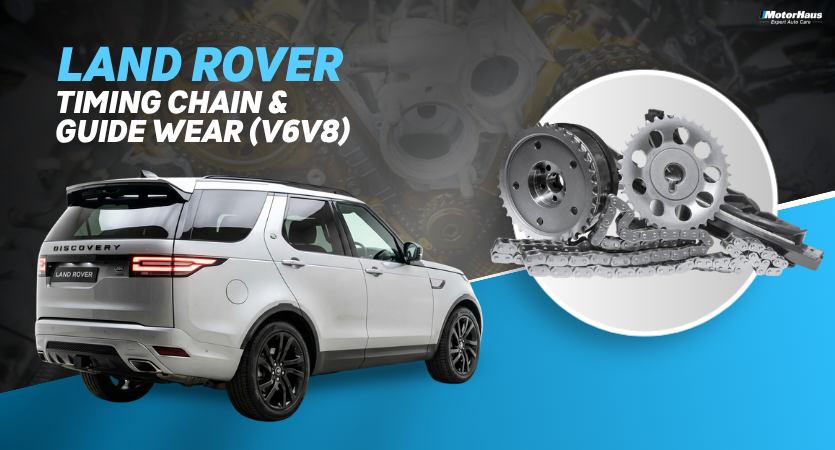
Cold start, first turn of the key, and the Range Rover rattles for three seconds. Warm restarts sound perfect. That noise is a worn timing chain guide letting the chain slap before oil pressure arrives. We recycle every drop we drain.
Oil service is the whole story here, and the EPA notes that one gallon of used motor oil yields as much lubricating base stock as 42 gallons of crude oil.
Quick Summary: Key Takeaways
- Cold-start rattle is the first symptom: Two to five seconds of noise. Then silence.
- Watch for correlation codes: P0016 through P0019 mean cam and crank timing has drifted.
- The 5.0L AJ133 V8 and 3.0L supercharged V6 are common patients: Both use plastic guides.
- Extended oil intervals cause it: Change every 5,000 to 7,500 miles in Florida heat.
- Fix it at the first rattle: A snapped chain means valves, pistons and a new engine.
Land Rover V6 and V8 engines drive their cams with chains and plastic guides
The 5.0L AJ133 V8 and 3.0L supercharged V6 both use a primary chain plus secondary chains to each head, and the chains themselves stretch very little. The guides wear.
Hydraulic tensioners fed by engine oil pressure hold tension, and molded plastic guides keep the chains from whipping around inside the front cover. Once that plastic thins or cracks, slack appears.
The tensioner cannot take it up fast enough. Oil has drained back to the sump overnight, so for the first couple of seconds the tensioner sits soft and the loose chain slaps the worn guide. That is why the noise is worst cold. Cold is the tell.
Six symptoms tell you the chain guides are worn
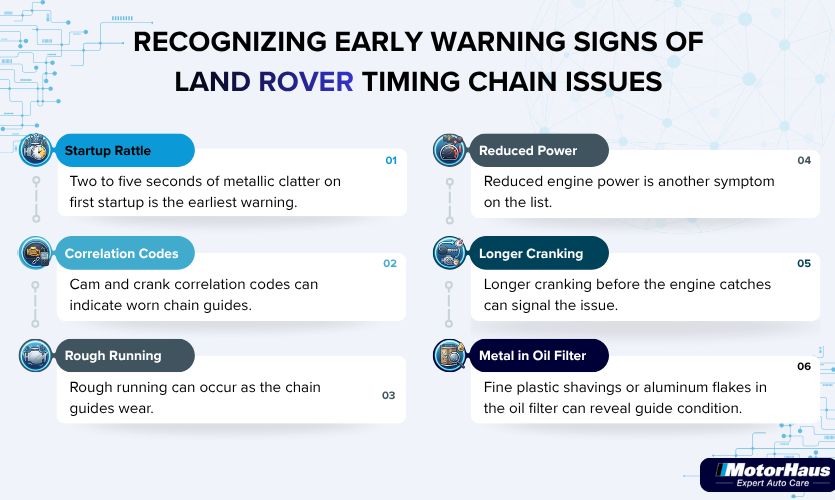
Start with the rattle: two to five seconds of metallic clatter on first startup, while warm restarts stay quieter or go silent altogether. That is your earliest warning.
From there the list runs to cam and crank correlation codes, rough running, reduced power, longer cranking before the engine catches, and metal glitter in the oil filter. Owners never think to ask about the filter.
Cutting one open is free during an oil change. Fine plastic shavings or aluminum flakes in the media tell us more about guide condition than any scan tool will. A rough idle alongside the rattle means timing already shifted. Do not ignore that.
Oil quality and stretched service intervals drive most chain guide failures
Tensioners run on oil pressure and guides depend on a constant oil film, so starve either one and wear accelerates fast. Long intervals are the culprit.
A Range Rover Sport crawling along Okeechobee Boulevard in August with the AC on and the supercharger heating everything works its oil far harder than the cycle those schedules assumed. Fifteen-thousand-mile changes do not protect chain hardware here.
Grade matters as much as mileage. Wrong viscosity changes how quickly the tensioner pressurizes on a cold start, which is exactly when the guides take their beating. We stay on spec and change at 5,000 to 7,500 miles. No exceptions.
A neglected chain can take the entire engine with it
Waiting costs the most on this repair, because slack grows, a guide breaks, and the chain either jumps a tooth or lets go entirely. Then physics takes over.
On an interference engine like the AJ133, pistons and valves try to occupy the same space, and the result is bent valves, damaged pistons and a scored head. On a ten-year-old truck that makes engine replacement the sensible option.
Compare that with acting early. A guide and tensioner job on a truck that is only rattling is a planned repair with a known number, and done once it goes another 100,000 miles. One visit.
Our West Palm Beach shop confirms chain wear before quoting the job
We verify before we open anything, and a chassis ear on the front cover locates the noise precisely. Live data shows timing deviation.
Then we cut the oil filter open, check oil level and condition, and rule out the sound-alikes that fool people into paying for a repair the engine never needed. A supercharger coupling, belt tensioner or alternator pulley can all mimic a chain rattle.
The 3.0L V6 is especially good at that. If chains and guides are the problem, we lay out the full job in writing, supercharger removal included. MotorHaus has held ASE Blue Seal recognition on Latham Road since 2012.
Frequently Asked Questions
Q: How much does a Land Rover timing chain replacement cost?
A: Not cheap. It is a large job, because the front cover and often the supercharger have to come off. We quote the specific engine and model year after confirming the fault, and we include chains, guides, tensioners, gaskets and seals so it is done once.
Q: Why does my Range Rover rattle for a few seconds on cold start?
A: Chain slack. A loose timing chain is slapping a worn guide before oil pressure builds in the tensioner. The noise disappears once pressure arrives, which is why warm restarts sound normal. Have it inspected while it is still only a noise.
Q: What do codes P0016 and P0017 mean on a Land Rover?
A: Timing drift. They are camshaft to crankshaft correlation codes. The module compares cam and crank sensor signals and reports that the two no longer line up. That usually means chain slack, a worn guide or a stuck variable valve timing solenoid.
Q: How often should I change the oil in a Land Rover V8?
A: Sooner than the book says. Every 5,000 to 7,500 miles with the specified grade, especially in South Florida where heat and stop-and-go traffic are normal. Timing chain hardware lives on clean oil, so a shorter interval is the cheapest protection available.
Bring the cold-start rattle in before it becomes an engine job
Move on this. A few seconds of noise is your window to fix this affordably. Contact our West Palm Beach team, describe what you hear and when, and we will diagnose the front of the engine.
Hours: Mon-Fri 8:00 AM to 5:00 PM; closed Saturday and Sunday
Website: motorhauspalmbeach.com