




It rained for twenty minutes on Okeechobee Boulevard. Now the Range Rover shows a suspension fault, a parking brake warning, a message about the transmission, and the tailgate won’t open. Nothing feels mechanically wrong.
That pattern is water, not four separate failures. Land Rover puts fuse boxes and control modules in low places — under the front seats, behind kick panels, under the battery tray — and West Palm Beach rain gets into all of them. Left alone through the wet months, a damp connector turns into green corrosion and a module you have to replace.
Quick Summary: Key Takeaways
- One cause, many warnings: A screen full of faults after rain means one wet connector, not a dozen broken parts.
- Water travels: It enters at a sunroof drain or a windshield seal, then runs down the wiring into whatever module sits lowest.
- Corrosion is the real damage: Drying the carpet does nothing once the connector pins have gone green.
- Faults come and go: Warnings that clear on a dry day and return after a storm mean moisture in a circuit.
- The season is not over: The Atlantic hurricane season runs into late November, so October rain is not the last chance a leak gets.
A Screen Full of Unrelated Warnings After Rain Has One Cause
Modern Land Rovers put roughly forty control modules on a shared network. When one of them loses a clean power or ground path, every other module that expects to hear from it logs a communication fault, and the driver gets the whole list at once.
So the dash lies to you, in a sense. It reports symptoms honestly while pointing nowhere useful, and chasing each message on its own is how an owner spends four figures replacing perfectly good parts before anybody thinks to lift the carpet. Start with what they share.
The useful question is different. What do all these circuits have in common, and where do they physically meet? Usually the answer is a single connector sitting in an inch of water.
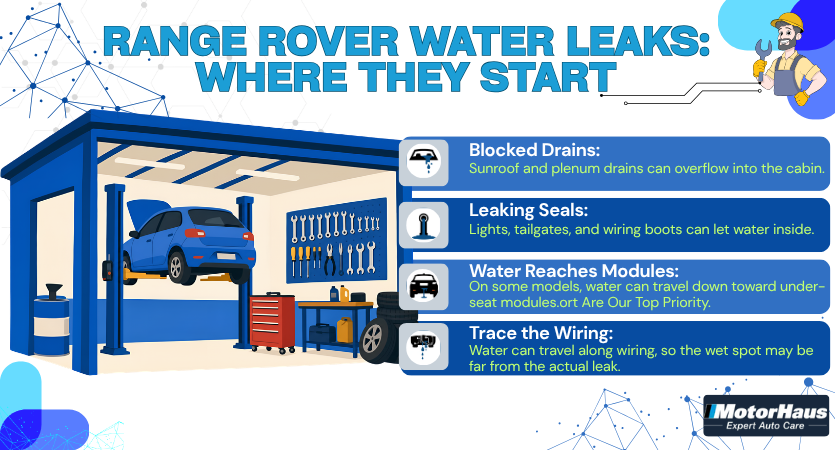
Water Gets In at Four Places and Ends Up in the Lowest Module
Start with the drains. They block. Sunroof drain tubes fill with pollen and dust, then overflow into the A-pillar and down onto the footwell. Plenum drains at the base of the windshield do the same thing, and on a Discovery or Range Rover Sport that path leads to modules mounted under the seats.
Then there are the seals — third brake light gaskets, rear light housings, tailgate grommets, and the rubber boot where the wiring passes through the body. Any one of them drips quietly for months before a single warning appears.
Water is patient. It wicks along the wire strands under the tape, so the wet spot is often two feet from the leak that caused it — which is why we trace the loom instead of replacing the module at the end of it.
Corrosion Is the Damage That Outlasts the Puddle
Water alone rarely kills a module outright. Corrosion does. Once moisture reaches the copper inside a connector the pins oxidize, resistance climbs, and a reference circuit that should sit at five volts starts reporting three and a half to a computer that has no way of knowing it is being lied to.
The module obeys what it measures. It sees an out-of-range signal, sets a fault, and drops into a limp strategy — which is why an air suspension warning can come from a corroded ground rather than a bad compressor.
Salt air speeds it up. Cars parked near the Intracoastal or driven out to Palm Beach every week corrode faster than the same vehicle inland, and once a pin is pitted the only real repair is cutting the connector out and splicing in a new one.
How the Diagnosis Actually Runs on a Wet Land Rover
First we get the whole fault list, not a summary. Reading every module gives us the map of which networks went quiet and in what order, and that narrows the search to one area of the car before anyone pulls a panel.
Then we go looking by hand. Carpet comes up, padding gets checked for damp, connectors come apart under a light, and we measure voltage drop across suspect grounds while wiggling the loom.
Sometimes we make it rain. A controlled water test on the sunroof, windshield base or tailgate reproduces the leak while someone watches inside with a flashlight, and that is usually the moment the mystery ends.
Battery voltage gets checked first, every time. A tired battery produces the same cascade of network faults as a wet connector, and there is no sense tearing a car apart to chase something a load test rules out in five minutes.
Palm Beach County Rain Keeps Coming After September
Do not treat this as a summer problem you outran. NOAA’s hurricane climatology puts the Atlantic season running from June 1 through November 30, with most activity between mid-August and mid-October, so a Range Rover with a clogged sunroof drain still has weeks of exposure ahead of it.
Ten minutes of prevention beats the repair. Pour water into each sunroof drain channel and watch for it behind the front wheels. If it pools, the tubes are blocked and the next storm lands in your carpet.
We are on Latham Road, minutes from I-95 and Palm Beach Lakes, and we work on Audi, BMW, Jaguar, Land Rover, Mercedes, MINI, Porsche and Volkswagen. Drivers from Jupiter, Lake Worth and Royal Palm Beach bring us cars that came back from other shops with the lights still on.
Frequently Asked Questions
Q: Why does my Range Rover show multiple warning lights at once?
A: Because the modules talk to each other. When one loses power, ground or communication, every module expecting to hear from it records a fault. A long list of unrelated warnings usually traces to one electrical problem — often water or a low battery.
Q: Where does water get into a Land Rover?
A: Blocked sunroof drain tubes, clogged plenum drains at the base of the windshield, failed third brake light or tail light seals, and body grommets where wiring passes through. From there it runs downhill into footwell and under-seat modules.
Q: Can a wet control module be dried out and reused?
A: Sometimes, if you catch it early and the connector pins are still clean. Once corrosion has pitted the pins or migrated into the circuit board, drying it just delays the next fault. We test rather than guess, because a module is an expensive coin flip.
Q: Does water damage cause suspension and transmission warnings?
A: It can, and often does. Air suspension height sensors, ride height modules and transmission control units all rely on small reference voltages. A corroded ground or a wet connector shifts those readings enough for the module to declare a fault and limp.
Find the Leak Before It Costs You a Module
Warning lights that follow the weather have a physical cause and it is findable. Book a diagnostic visit and we will read every module, trace the harness and show you where the water is getting in.
Hours: Mon-Fri 8:00 AM-5:00 PM; Sat-Sun closed
Website: motorhauspalmbeach.com